BEGIN:VCALENDAR
VERSION:2.0
CALSCALE:GREGORIAN
METHOD:PUBLISH
PRODID://CTSL//220861
BEGIN:VEVENT
DTSTAMP:20260820T085205
VTIMEZONE:America/Los_Angeles
DTSTART:20260925T220000Z
DTEND:20260925T230000Z
UID:220861
SUMMARY:Fast Reading Aloud and Shadowing: Bottom-Up Processing in L2 Listening (TOP-IG)
LOCATION:CATESOL Zoom
DESCRIPTION:Fast Reading Aloud and Shadowing: Bottom-Up Processing in L2 Listening (TOP-IG)\n\n09/25/26 03:00 PM PST\n - 09/25/26 04:00 PM PST\Description:\n\n\nDescription\n\nThe speed of aural input is commonly reported as one of the greatest challenges that L2 learners face when listening. A primary cause of this challenge lies in learners’ bottom-up processing, during which they identify the phonological information, convert it into lexical items, and organize these based on their syntactic knowledge.\n\nTo enhance learners’ bottom-up processing, two activities can be recommended: shadowing and fast reading aloud. In this presentation, the presenter will share the research findings on the effects of these activities on learners’ bottom-up processing. Although previous research has found shadowing to be effective in improving learners’ bottom-up processing in L2 listening, the speaker’s recent study, conducted at a Japanese university in Tokyo, found that fast reading aloud is significantly more effective than shadowing. The possible reasons for these inconsistent findings on the effects of shadowing will be discussed.\n\nIn the talk, the presenter will also demonstrate how easily fast reading aloud can be implemented, both in and outside the classroom, allowing participants to experience the immediate effects of the process.\n\nPresenter\n\nDr. Katsuya Yokomoto is an Associate Professor at the Center for Language Education and Research at Sophia University in Tokyo. He has been teaching English for over 25 years in various contexts, including in the United States, China, and Japan. As a Japanese learner of English as a foreign language, he has long been fascinated by the learning and teaching of English pronunciation. His research interests include pronunciation teaching, World Englishes, teacher cognition, and the teaching of neurodivergent learners.\n\nHosts\n\nTeaching of Pronunciation Interest Group (TOP-IG)\nMarsha Chan and Patryk Mrozek. Co-coordinators\nDonna Brinton, Assistant Coordinator\n\nDate and Time \n\nFriday, September 25, 2026, 3:00-4:00 PM California Time (September 26, 7:00 AM Tokyo time)\n\nCost\n\nMembers: Free\nNon-members: $5.00\n\n#catesoltop\n\Location:\nCATESOL Zoom\n\n,
X-ALT-DESC;FMTTYPE=text/html:Fast Reading Aloud and Shadowing: Bottom-Up Processing in L2 Listening (TOP-IG)
09/25/26 03:00 PM PST - 09/25/26 04:00 PM PST
Description:
Description
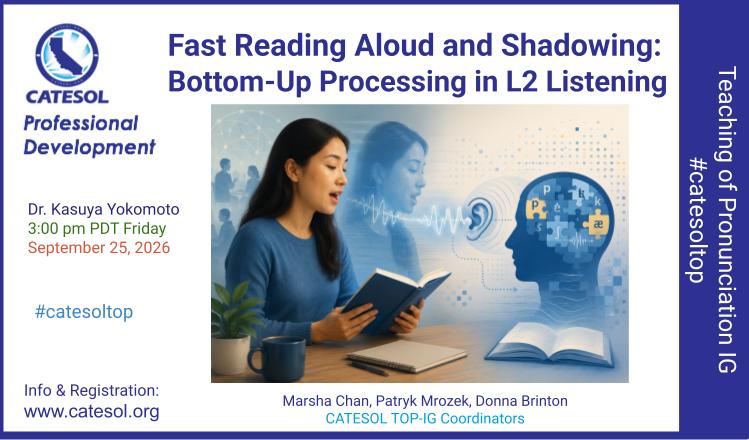
The speed of aural input is commonly reported as one of the greatest challenges that L2 learners face when listening. A primary cause of this challenge lies in learners’ bottom-up processing, during which they identify the phonological information, convert it into lexical items, and organize these based on their syntactic knowledge.
To enhance learners’ bottom-up processing, two activities can be recommended: shadowing and fast reading aloud. In this presentation, the presenter will share the research findings on the effects of these activities on learners’ bottom-up processing. Although previous research has found shadowing to be effective in improving learners’ bottom-up processing in L2 listening, the speaker’s recent study, conducted at a Japanese university in Tokyo, found that fast reading aloud is significantly more effective than shadowing. The possible reasons for these inconsistent findings on the effects of shadowing will be discussed.
In the talk, the presenter will also demonstrate how easily fast reading aloud can be implemented, both in and outside the classroom, allowing participants to experience the immediate effects of the process.
Presenter
Dr. Katsuya Yokomoto is an Associate Professor at the Center for Language Education and Research at Sophia University in Tokyo. He has been teaching English for over 25 years in various contexts, including in the United States, China, and Japan. As a Japanese learner of English as a foreign language, he has long been fascinated by the learning and teaching of English pronunciation. His research interests include pronunciation teaching, World Englishes, teacher cognition, and the teaching of neurodivergent learners.
Hosts
Teaching of Pronunciation Interest Group (TOP-IG)
Marsha Chan and Patryk Mrozek. Co-coordinators
Donna Brinton, Assistant Coordinator
Date and Time
Friday, September 25, 2026, 3:00-4:00 PM California Time (September 26, 7:00 AM Tokyo time)
Cost
Members: Free
Non-members: $5.00
#catesoltop
Location:
CATESOL Zoom
,
PRIORITY:3
TRANSP:TRANSPARENT
BEGIN:VALARM
TRIGGER:-PT5M
ACTION:DISPLAY
DESCRIPTION:Reminder
END:VALARM
END:VEVENT
END:VCALENDAR